
Meteor Crater Natural Landmark
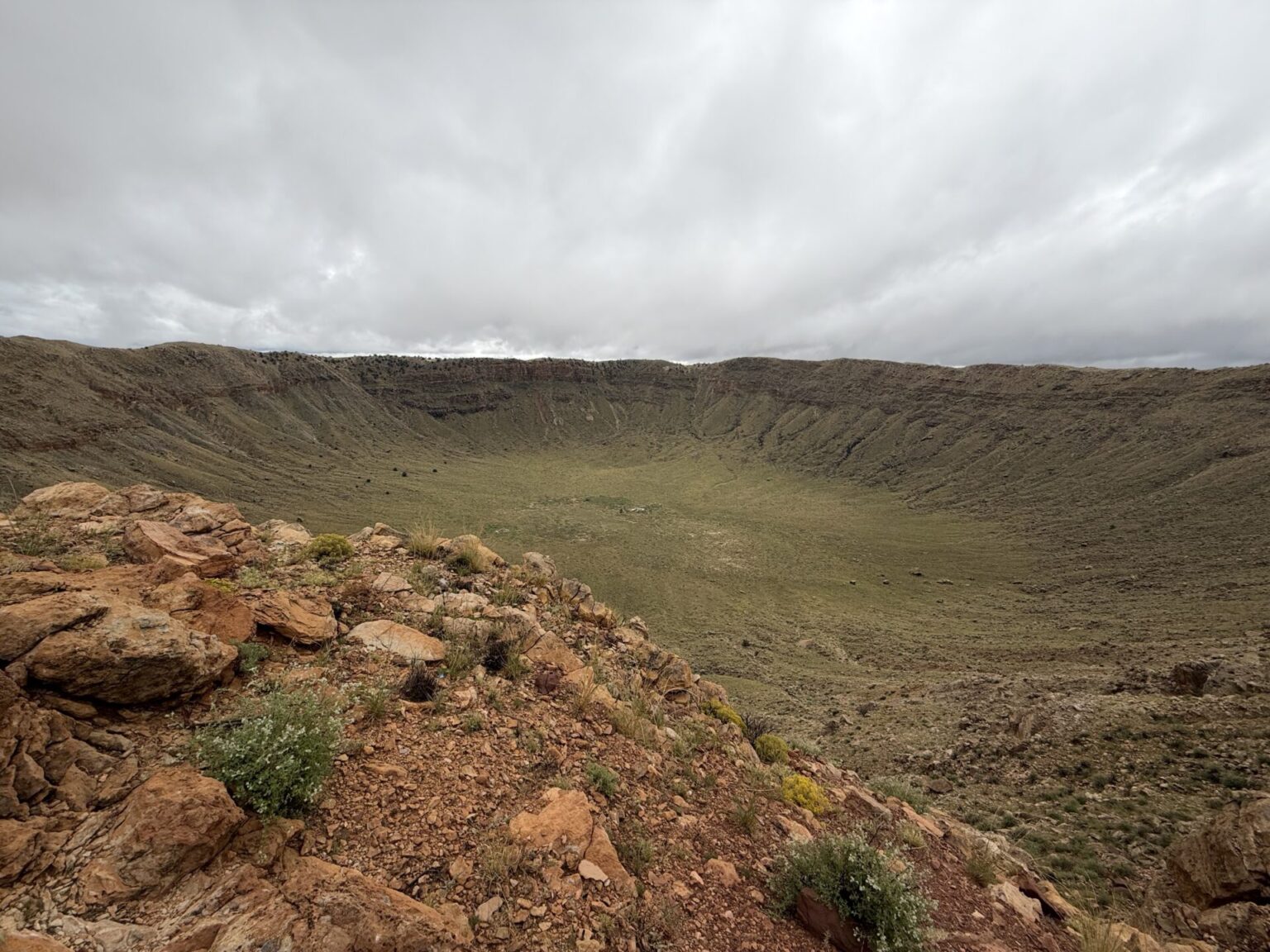
Meteor Crater is one of those places that looks impressive in photos, but the scale does not really register until you are standing on the rim.
About 50,000 years ago, an iron-nickel asteroid slammed into what is now northern Arizona at enormous speed, excavating a crater roughly a mile wide and hundreds of feet deep. Because of the dry climate and relatively young geological age, the site remains exceptionally well preserved. NASA describes it as one of the most intact impact craters on Earth.
For a long time, however, scientists did not agree on what created it. Many believed the crater was volcanic. That began to change in the early 1900s when mining engineer and businessman Daniel Moreau Barringer became convinced that a giant meteorite had struck the site. Barringer believed a massive body of iron and nickel was still buried beneath the crater floor, and in 1903 he began acquiring mining claims and organizing what became the Barringer Crater Company.
Barringer spent decades drilling, digging shafts, and searching for the meteorite he believed would make him a fortune. The search ultimately failed. What Barringer did not understand at the time was that most of the enormous meteorite had melted or vaporized during the impact, leaving only scattered fragments behind. He lost much of his fortune pursuing the buried mass and continued the effort until his death in 1929.
He was wrong about the fortune beneath the crater, but he was right about something far more important: the crater had been formed by an extraterrestrial impact.
Barringer and physicist Benjamin Chew Tilghman gathered evidence including meteoritic iron mixed with rocks thrown from the crater, pulverized silica, and overturned rock layers. Even then, the impact explanation remained controversial for decades. It was not until the work of geologist Eugene Shoemaker in the 1950s and 1960s that the impact origin was conclusively demonstrated and broadly accepted. Meteor Crater became the first crater on Earth scientifically confirmed as having been created by an extraterrestrial impact.
The story did not end with mining.
Barringer’s descendants preserved the property rather than developing it extensively, and the crater eventually became a destination for visitors, researchers, and scientists. The family still owns and operates the site today, now six generations later, with preservation, science, and public access at the center of the operation.
Its scientific importance also extends far beyond Arizona. Because Meteor Crater is so well preserved, researchers use it as a natural laboratory for understanding how impact craters form on Earth, the Moon, and other planetary bodies. NASA and planetary scientists have studied the site extensively for exactly that reason.
That connection became especially important during the space program. Eugene Shoemaker helped train Apollo astronauts in field geology, using places like Meteor Crater and the surrounding northern Arizona terrain to teach astronauts how to recognize geological features they might encounter on the Moon. The site remains connected to astronaut training, planetary science, and research today.
Standing at the rim, it is easy to understand why.
Meteor Crater is nearly a mile across and roughly 550 to 570 feet deep today. When it originally formed, NASA estimates it was about 700 feet deep before erosion and sediment gradually filled part of the crater.
What began as one man’s unsuccessful search for nickel and iron eventually became something much more valuable: one of the clearest pieces of evidence on Earth showing what happens when a large object from space hits our planet.
And more than a century after Barringer began digging, scientists and astronauts are still learning from it.